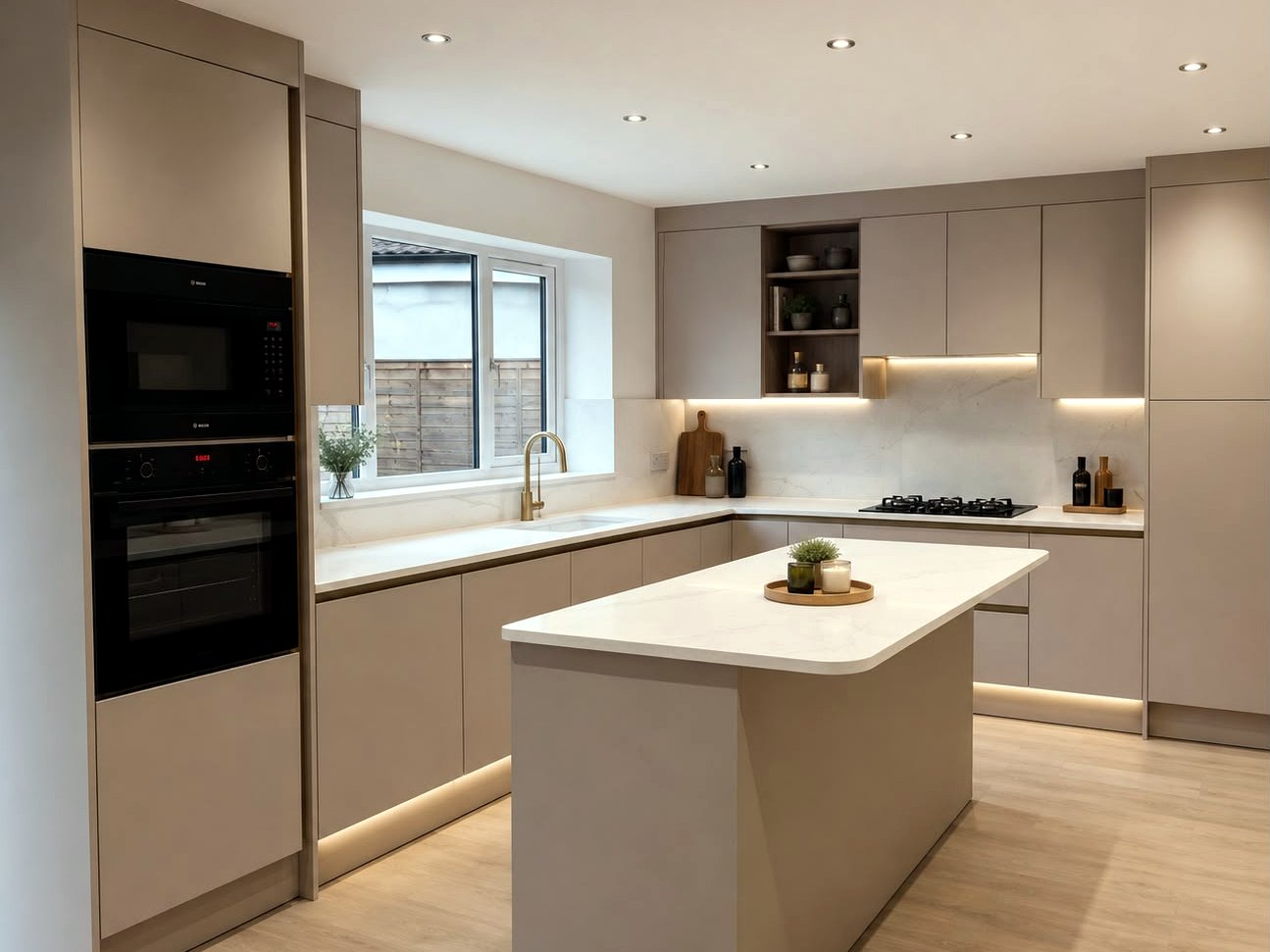
This question comes up in almost every consultation, usually phrased as "is it solid wood or just chipboard?" It is a fair thing to ask — but the framing hides something important, which is that solid wood carcasses barely exist, and the things that actually determine whether your kitchen still works properly in fifteen years are almost never the things people ask about.
Here is what is genuinely going on, without the sales language.
The uncomfortable truth: almost nobody builds solid wood carcasses
When a company advertises a "solid wood kitchen", they are nearly always describing the doors and sometimes the face frames — not the boxes behind them. The carcasses will be engineered board, and that is true right up to the top of the market. Companies charging £50,000 for a kitchen are using engineered board carcasses.
This is not cost-cutting. It is the correct engineering decision, and it comes down to one property: movement.
Why solid timber is the wrong material for a box
Solid wood expands and contracts across its width as humidity changes. In a British kitchen — where the air goes from dry central heating in February to steam from a boiling pan on a wet November evening — that movement is continuous.
A traditional cabinetmaker accommodates this. Frame-and-panel doors are designed so a solid panel floats within a frame and can move without splitting. That is centuries-old joinery and it works beautifully.
A carcass has the opposite requirement. It needs to stay dimensionally fixed, hold hinges in precise alignment, and remain square so that eight doors along a run all line up with each other. A material that grows and shrinks by several millimetres across a 600mm panel is actively working against that. Solid wood carcasses would move seasonally, throw doors out of alignment, and stress the joints holding the box together.
So the real comparison is not Egger versus solid wood. It is between the engineered boards.
The materials that actually compete
Melamine Faced Chipboard (MFC) — what Egger makes
A particleboard core with melamine bonded to both faces under heat and pressure. This is the industry standard for carcass construction, and it earns that position honestly.
- Dimensionally stable — it does not move with humidity, which is the entire point
- Very hard wearing surface — melamine resists scratching and cleans easily, and it will not need finishing or resealing
- Consistent — every sheet is flat and identical, which matters when you are manufacturing dozens of units to fit together
- Available moisture-resistant — P3 grade board (usually green-tinted in the core) handles the damp of a real kitchen
- Cost-effective — which frees budget for hardware and internals, where it does more good
The honest weakness: if water sits on an unsealed cut edge for a sustained period — a slow leak under a sink over weeks, not a spill you wipe up — the core can swell, and that damage is permanent. This is why edge banding quality matters so much, and why we use moisture-resistant board in sink and utility runs as standard.
Plywood
Thin veneers laminated with alternating grain direction. Genuinely excellent material with real advantages.
- Better screw retention — holds fixings more securely, which matters for heavy loads and repeated adjustment
- Stronger for its weight, and better across long unsupported spans
- Copes better with prolonged damp — it will not swell the way chipboard can
The trade-offs are real too: it costs considerably more, the edges need finishing or they look raw, and large sheets are not always as reliably flat as MFC. For most domestic kitchens the performance gain does not justify the cost — the money buys more if it goes into drawer runners and internal storage. Where plywood does earn its place: unusually wide spans, very heavy stone worktops, or genuinely damp environments.
MDF
Fine fibres compressed with resin. Superb for doors — it machines to crisp profiles and takes paint better than almost anything, which is why the vast majority of painted Shaker doors are MDF rather than timber. As a carcass material it is heavy, and standard grades handle moisture poorly. Moisture-resistant MDF exists and is good, but it rarely beats MFC on cost or weight for box construction.
Solid timber
Belongs in doors, drawer boxes, in-frame face frames and worktops. Beautiful, repairable, and it can be sanded back and refinished decades later. Just not the right material for a carcass, for the reasons above.
The six things that matter more than the material name
If you take one thing from this article, take this. Two kitchens can both honestly claim "18mm Egger carcasses" and be built to completely different standards. Here is what actually separates them — and what to ask about.
1. Board thickness
18mm is the benchmark. Budget kitchens often drop to 15mm, and sometimes 12mm for shelves. This is where sagging shelves come from, and where units flex during installation. Ask for it in writing.
2. Moisture-resistant grade
P3 moisture-resistant board should be standard throughout, not an upgrade and not confined to the sink unit. Dishwasher leaks and washing machine overflows do not respect specification boundaries.
3. Edge banding
Every exposed edge should be properly banded, ideally with 2mm ABS rather than thin paper-backed tape. This is the seal that keeps moisture out of the core. Thin tape lifts at corners over time, and once it lifts the edge is exposed. Check the rear edges too — it is a common place to save money because nobody looks there.
4. The back panel
A full-thickness back rebated into the sides keeps the unit square permanently. A thin hardboard sheet stapled to the back edges contributes almost nothing structurally. Over ten or fifteen years, units built the second way can rack slightly out of square — and that, not the doors themselves, is usually why doors stop lining up in an older kitchen.
5. How the box is assembled
Dowelled and glued construction is significantly more rigid than cam-and-dowel knock-down fittings. Rigid, pre-assembled units are stronger than flat-pack assembled on site — which is also why they cost more to deliver.
6. Hardware
Hinges and drawer runners are the parts you physically touch every day, and they fail long before the box does. Quality soft-close hardware with a lifetime guarantee — Blum, Hettich and similar — is worth more to your daily experience than any carcass material upgrade. This is where we would always spend first.
What we use, and why
BFK build on 18mm moisture-resistant Egger board throughout — not just the sink run — with 2mm edge banding to exposed edges, full-thickness rebated backs, and quality soft-close hardware as standard.
We chose that specification because it is genuinely the right answer for the overwhelming majority of British homes, not because it is the cheapest. Where a project needs something different — plywood for an unusually wide span, or a particular internal finish — we will specify it and tell you what it costs.
What we will not do is describe our kitchens as "solid wood" because the doors are timber. That is technically defensible and practically misleading, and it is the sort of thing that makes this industry harder to navigate than it needs to be.
Questions worth asking any supplier
Whoever you end up using, these five questions will tell you more than an hour in a showroom:
- What thickness is the carcass board, and is it moisture-resistant throughout?
- What edge banding do you use, and is it applied to all exposed edges including the rear?
- Is the back panel full thickness and rebated, or stapled hardboard?
- Are units delivered rigid and pre-assembled, or flat-packed and built on site?
- What hinges and runners are fitted, and what is the guarantee on them?
A supplier who answers all five clearly and without hedging is telling you something useful about how they work. One who deflects to talking about door finishes is telling you something too.
If you would like our full written specification before committing to anything, just ask — we will send it. You can also see how the finished result looks in our portfolio, or read our guide to bespoke kitchen costs for how specification affects price.
Frequently asked questions
Are solid wood kitchen carcasses better than Egger MFC?
For carcasses specifically, no — and almost no manufacturer builds them from solid wood. Solid timber expands and contracts with humidity, which is a real problem for a box that must stay square and hold doors in alignment. Engineered boards are dimensionally stable, which is why they are the industry standard. Solid wood belongs in doors, drawer boxes and in-frame face frames, where the design can accommodate movement.
Is plywood better than chipboard for kitchen units?
Plywood has genuine advantages — better screw retention, higher strength for its weight, and better tolerance of prolonged damp. It also costs considerably more. For most domestic kitchens, quality 18mm moisture-resistant MFC performs extremely well and the extra money does more good in hardware and internal storage. Plywood makes sense for very wide unsupported spans or unusually damp environments.
How thick should kitchen carcasses be?
18mm is the standard to look for. Budget kitchens sometimes use 15mm or 12mm for sides and shelves, which is where sagging shelves and flexing units come from. Ask for the thickness in writing — it is an easy place for a quotation to save money invisibly.
What does P3 moisture-resistant board actually mean?
P3 is a European board grade indicating resistance to humid conditions. The core is usually tinted green so it can be identified on a cut edge. It is not waterproof — no chipboard is — but it handles the normal humidity of a kitchen and short-term spills far better than standard board. It should be specified throughout, not just under the sink.
If the carcass material is standard, what am I paying more for in a bespoke kitchen?
Mainly three things: units built to your exact dimensions rather than assembled from stock sizes, door and finish quality, and the design and installation work around them. A bespoke kitchen fills the room properly — no filler panels, no dead corners, no compromise on the island size. The carcass material being industry-standard is a feature, not a shortfall.