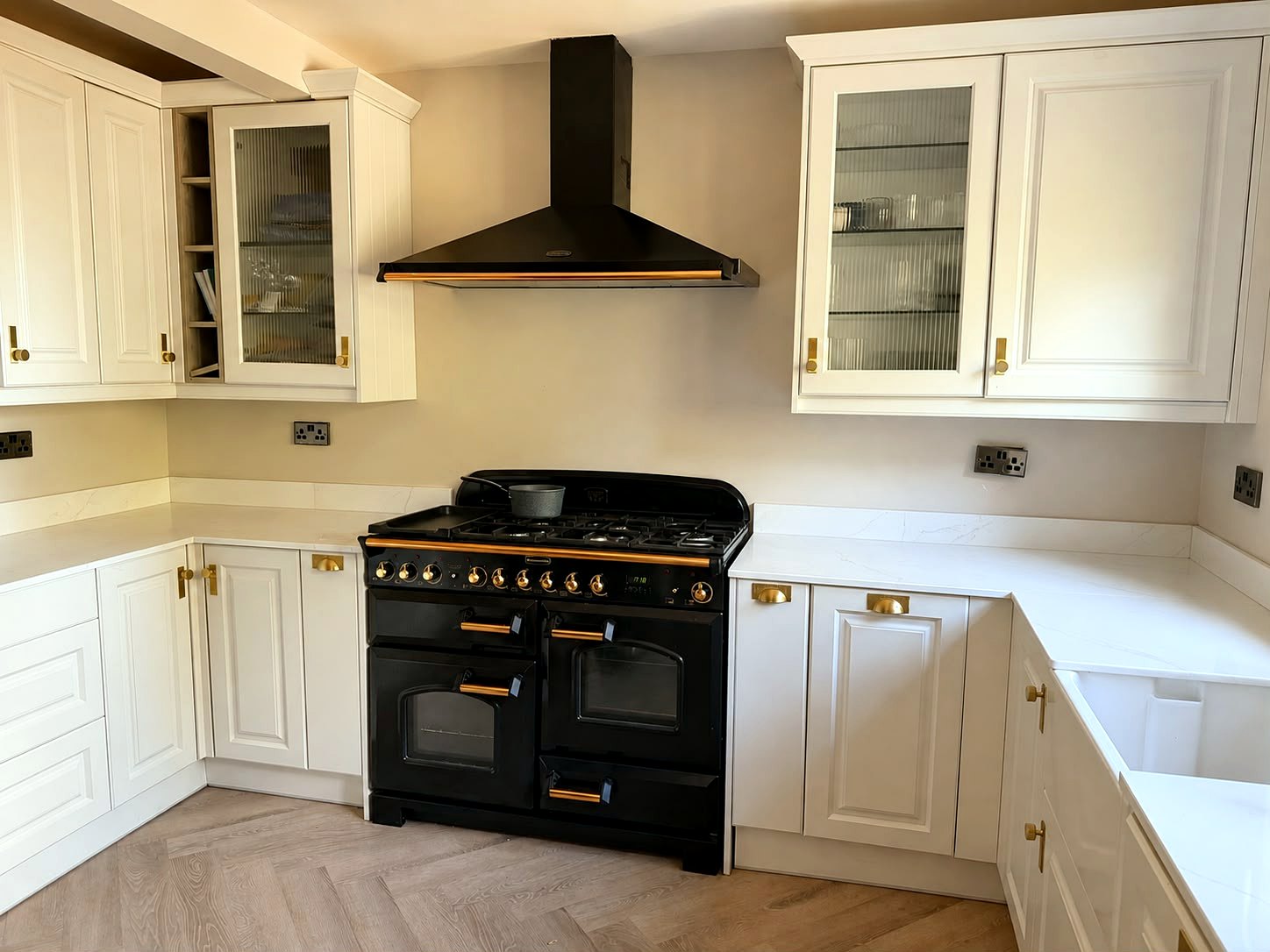
Cream in-frame kitchen with aged brass cup handles and knobs, installed by BFK
Why Hardware Matters

Small components, disproportionate effect.

Handles are the one part of a kitchen you make physical contact with several times a day. They are also the cheapest element to specify well and the most expensive to change your mind about later.

We work with Hendel & Hendel, a British hardware designer established in 1971 and based in Lincoln. Their pieces are manufactured in solid brass and zamac, lacquered, and carry a lifetime product guarantee.

We chose them for two practical reasons rather than brand appeal. First, the collections are broad enough that a single family covers knobs, cup handles, bar pulls, appliance pulls and backplates — so a whole kitchen can be specified from one design language rather than assembled from mismatched parts. Second, the finish quality holds up: lacquered brass that keeps its tone rather than going patchy after a year of cleaning.

Handle selection happens at design stage, not at the end. We drill in the workshop rather than on site, so the choice needs to be locked before manufacture — which also means every hole is in exactly the right place.
What We Supply

Every touchpoint, from one family.

The Hendel & Hendel catalogue covers the full range of cabinet hardware. Most schemes use three or four of the categories below, drawn from a single collection.

Cabinet Pull Handles

Bar and T-bar pulls in a range of centres, for drawers, doors and tall units.

Cabinet Knobs

Round, oval and faceted knobs — the traditional choice for Shaker and in-frame doors.

Cup Handles

Recessed pulls for drawer fronts. Classic pairing with knobs on a painted kitchen.

Appliance Pull Handles

Longer, heavier pulls sized for integrated fridge, freezer and larder doors.

Handle Backplates

Mix-and-match plates behind knobs and pulls, for a more decorative period look.

Drop Handles

Hinged pulls with a traditional character, well suited to dressers and pantries.

Catches & Latches

Surface latches for in-frame doors and glazed cabinets, where a visible closure suits the style.

Coat Hooks

For boot rooms, utility runs and hallway joinery — matched to the rest of the scheme.

Shelf Brackets

Exposed brackets for open shelving, in finishes that tie back to the cabinetry hardware.

Skirting Protectors

A small detail for high-traffic runs, in matching metalwork.

The Collections

Fifteen families, three broad characters.

Each collection runs across multiple product types and finishes, so you can specify a whole room without mixing design languages. Grouped below by the interiors they tend to suit.

01

Traditional

Period detailing, softer curves and decorative backplates. Best suited to in-frame, Shaker and classic painted kitchens.

  • Greenwich — gentle curves, understated British-architectural detailing
  • Barrington — cup handles, D-bars, round knobs and matching backplates
  • Bailgate — traditional profile with a heavier, hand-made character
  • Scroll — softened detail inspired by unfurling parchment
  • Newbridge — classic proportions for period properties
02

Transitional

Pieces that sit comfortably in both directions — clean enough for a contemporary scheme, warm enough for a classic one. The safest choice in an open-plan space.

  • Hempstock — square bar with a clasp detail, British-American styling
  • Belgravia — refined, restrained, well proportioned
  • Callcott — simple forms with subtle articulation
  • Fitzrovia — understated urban character
  • Austin — clean lines with a slight traditional lean
03

Contemporary

Minimal profiles and sculptural forms. Pairs naturally with handleless runs, slab doors and matt finishes.

  • Okus — graceful curves meeting a circular bar
  • Brokk — bold, architectural, strongly geometric
  • Hoxa — pared-back contemporary profile
  • Ark — arched form, sculptural but restrained
  • Felix — slim and unobtrusive
  • Fenton — industrial-inspired, primarily hooks
Finishes

Choosing metal that works with the room.

Finish availability varies by collection — we confirm the exact options for your chosen handle at design stage. These are the families you will be choosing between.

Polished Brass

Bright, warm and reflective. Strong against dark cabinetry.

Satin Brass

The same warmth without the shine. The most-specified finish we fit.

Antique / Aged Brass

Darkened and slightly uneven. Suits period and in-frame schemes.

Bronze

Deep and brown-toned. Excellent with green, navy and timber.

Matt Black

Graphic and contemporary. Reads well against pale cabinetry.

Polished Chrome

Cool and bright. The default for modern handleless schemes.

Satin Nickel

Softer and warmer than chrome, without going gold.

Pewter

Muted grey with depth. Quietly traditional.

Swatches above are indicative only — metal finishes photograph and render differently to how they look in a room. We supply physical samples before you commit.

Getting It Right

How we specify hardware.

Five things we resolve before anything is drilled.

01

Handle Before Manufacture

Drilling happens in the workshop, not on site. The handle is confirmed at design stage so every centre is exact.

02

Scale to the Door

A 160mm bar on a 300mm drawer looks wrong. Handle lengths are stepped to suit each cabinet width.

03

Knobs and Pulls Together

Knobs on doors, cup handles or bars on drawers. Traditional, and practical — drawers need a wider grip.

04

Coordinate the Metals

Handles, tap, sink and light fittings should agree. We check the tap finish before signing off hardware.

05

Samples First

Metal finishes never look the same on screen. We get physical samples into the room before ordering.

06

Appliance Pulls Sized Up

Integrated fridge and larder doors are tall and heavy. They need longer, more substantial pulls than base units.

Common Questions

Ironmongery, answered.

Can I choose my own handles for a bespoke kitchen?

Yes. Handles are specified as part of your design rather than fixed to a package. We supply the Hendel & Hendel collections as standard, and we can work to another manufacturer if you have already chosen something. Because we drill in the workshop rather than on site, the choice needs confirming before manufacture.

What finishes are available for kitchen cabinet handles?

Common finishes across the collections include polished and satin brass, antique and aged brass, bronze, matt black, polished and satin chrome, nickel and pewter tones. Availability varies by collection, so we confirm the exact options for your chosen handle at design stage.

Should I use knobs or handles on a Shaker kitchen?

A common approach is knobs on doors with cup handles or bar pulls on drawers — traditional, and practical, since drawers benefit from a wider grip. There is no rule, and mixing within one collection keeps the scheme coherent. Consistency of finish across the room matters more than the specific mix.

Can handles be mixed with a handleless kitchen?

Yes, and it is increasingly common. A true handleless run to the main cabinetry with handles on an island, pantry or dresser creates deliberate contrast and stops a large kitchen feeling flat. We specify the handle at design stage so rail and drilling positions are resolved together.

Do handles come with a guarantee?

Hendel & Hendel provide a lifetime product guarantee on their hardware. As with any lacquered finish, that covers manufacturing rather than wear caused by abrasive cleaning products — we supply care guidance on handover.

Can I change handles later if I go off them?

Within reason. Swapping like-for-like — a bar pull for another bar pull with the same centres — is straightforward. Moving from knobs to handles, or changing centres, means new holes, which on a painted door is a repair rather than a swap. It is worth spending the extra time on this decision up front.

Start a Project

See the hardware in your hand.

Handles are impossible to judge on a screen. Tell us what you are planning and we will get physical samples in the right finishes to you.