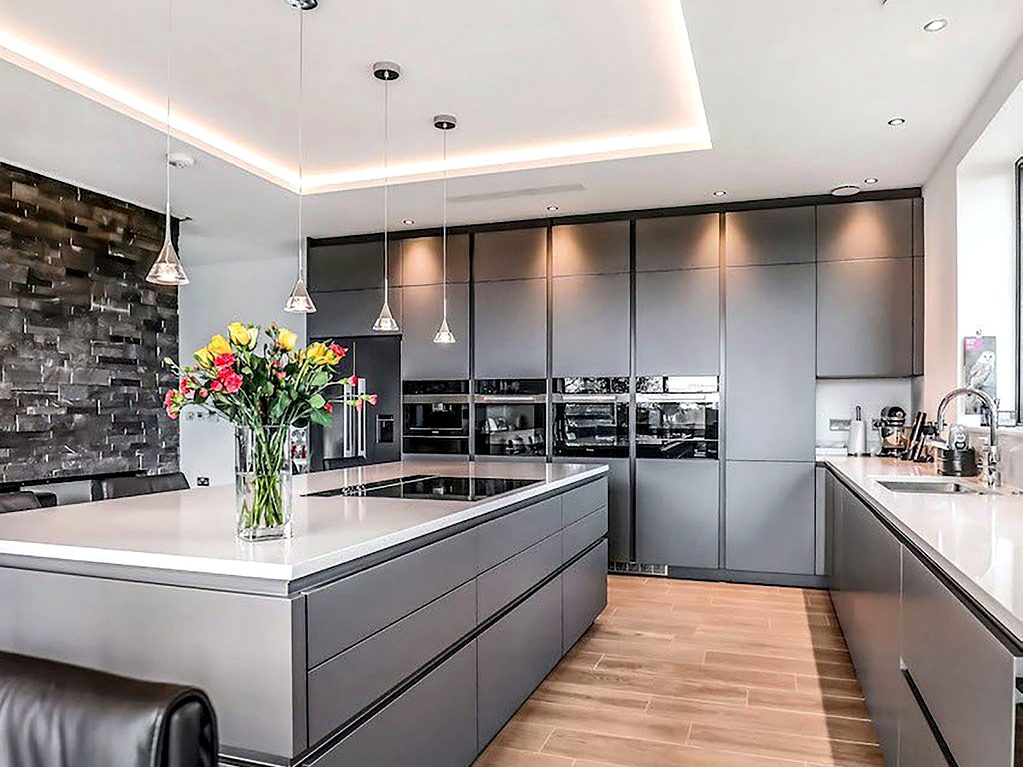
Kitchen pricing in the UK is deliberately opaque. Showrooms quote "from" prices that no real kitchen has ever cost, and online estimators produce numbers that collapse the moment someone measures your room. This guide gives you the actual bands we see, and — more usefully — explains what moves you between them.
The short answer
For 2026, most bespoke fitted kitchens in the UK land between £12,000 and £45,000 including units, worktops, installation and VAT. That is a wide range because "bespoke kitchen" covers everything from a compact galley to a forty-square-metre open-plan scheme with a butler's pantry.
Typical price bands
- £12,000 – £18,000 — Compact galley or small L-shape. Painted or vinyl-wrapped doors, laminate or entry-level quartz worktop, standard cabinet depths, no island.
- £18,000 – £30,000 — Mid-size family kitchen, usually with an island or peninsula. Painted Shaker or handleless doors, quartz worktop, integrated appliances, some tall storage.
- £30,000 – £45,000 — Large open-plan kitchen-diner. Premium stone, full-height larders, feature island with waterfall ends, bespoke internal storage, often a matching utility run.
- £45,000+ — Heavily specified schemes: marble or book-matched stone, in-frame cabinetry, integrated wine storage, pantry rooms, high-end appliance packages.
These figures exclude appliances unless stated, and exclude building work. More on that below.
The six things that actually drive the price
1. The number of units — not the size of the room
People assume cost scales with floor area. It scales with cabinet count. A large kitchen with a modest run of units along one wall can cost less than a small kitchen packed with tall larders on three sides. If you are trying to control budget, reducing tall units is more effective than reducing room size.
2. Door style and finish
This is the single biggest swing factor. Roughly, from least to most expensive: vinyl-wrapped, then sprayed matt, then painted Shaker, then in-frame, then hand-painted timber. The gap between a wrapped door and a genuine in-frame painted door across a full kitchen can be £6,000 or more — for cabinets that are otherwise identical inside.
3. Worktop material
Worktops routinely account for 15–25% of a kitchen budget. Laminate starts around £600 for a small kitchen; quartz typically runs £2,500–£5,000; marble and book-matched stone can exceed £8,000. Waterfall island ends, upstands, splashbacks and drainer grooves all add. Our stone worktops page compares the materials in detail.
4. Carcass quality
The part you never see and cannot easily change later. Moisture-resistant board, solid backs, proper edge banding and quality soft-close hardware cost more up front and are the difference between a kitchen that still closes properly in year twelve and one that does not. Ask what board is used and what the hinge warranty is — the answers are revealing.
5. Internal storage
Pull-out larders, corner carousels, cutlery inserts, bin systems, drawer-in-drawer arrangements and spice racks are individually modest and collectively significant. It is easy to add £2,000–£4,000 in internals without noticing. They are also, in our experience, the parts clients are most glad they paid for.
6. Appliances
Frequently the most underestimated line. A mid-range integrated appliance package — oven, hob, extractor, fridge-freezer, dishwasher — typically runs £3,000–£6,000. Premium brands can triple that. Decide your appliance budget early, because appliance dimensions dictate cabinet design and changing them late means re-drawing.
What most quotations leave out
This is where kitchen budgets go wrong. A quotation for units and worktops is not a quotation for a finished kitchen. Budget separately for:
- Removal and disposal of the existing kitchen — £400–£900 typically
- Plumbing and electrical first fix — moving a sink or adding sockets, £800–£2,500
- Plastering and making good after old units come off the wall — £500–£1,500
- Flooring — usually laid after units, £1,000–£4,000 depending on material
- Tiling and splashbacks if not using stone — £400–£1,200
- Decorating — walls and ceiling after installation, £500–£1,200
As a working rule, add 20–30% to your cabinetry quotation to reach a realistic all-in figure, unless your quotation explicitly includes the trades above.
Where to spend and where to save
If your budget is fixed and something has to give, here is the order we would sacrifice things in:
- Save on: door style before carcass quality. A simpler door on an excellent cabinet ages far better than the reverse.
- Save on: the worktop in secondary areas — use premium stone on the island and something more modest on the back run if the two are visually separate.
- Spend on: hardware and internal storage. These are daily-contact items and are disproportionately expensive to retrofit.
- Spend on: getting the layout right. No finish rescues a kitchen where the dishwasher blocks a drawer or the oven opens into a walkway.
How BFK quote
We provide a fixed written quotation after a site measure, itemised by unit so you can see where the money is going and adjust before committing. We will also tell you plainly if a bespoke kitchen is not the right answer for your room — if stock sizes fit your space well, you may be better served elsewhere, and we would rather say so than sell you something you do not need.
Explore our kitchen styles and finishes, or see completed installations in the portfolio.
Frequently asked questions
Is a bespoke kitchen worth it compared to an off-the-shelf one?
It depends on your room. Where stock cabinet sizes fit neatly, an off-the-shelf kitchen can be excellent value. Bespoke earns its cost where the room is awkward — chimney breasts, sloped ceilings, non-standard heights — or where you want a specific finish, a particular island size, or storage designed around how you actually cook.
How long does a bespoke kitchen take from order to installation?
Typically eight to twelve weeks from approved drawings. Design and technical review take two to three weeks, manufacture four to six weeks, and installation one to two weeks on site. Stone worktops are templated after units are fitted and add a further one to two weeks.
Do you need to pay a deposit?
Yes. A deposit of 25–50% at order is standard across the industry, because units are manufactured specifically for you and cannot be resold. Be cautious of any company asking for the full amount up front, and make sure the payment schedule is written into your contract.
Can you phase the work to spread the cost?
Sometimes. Splitting a kitchen from a utility room or a separate pantry is straightforward. Splitting the kitchen itself rarely works well, because worktops are templated as one piece and units are installed as a single run — doing it twice costs more than doing it once.